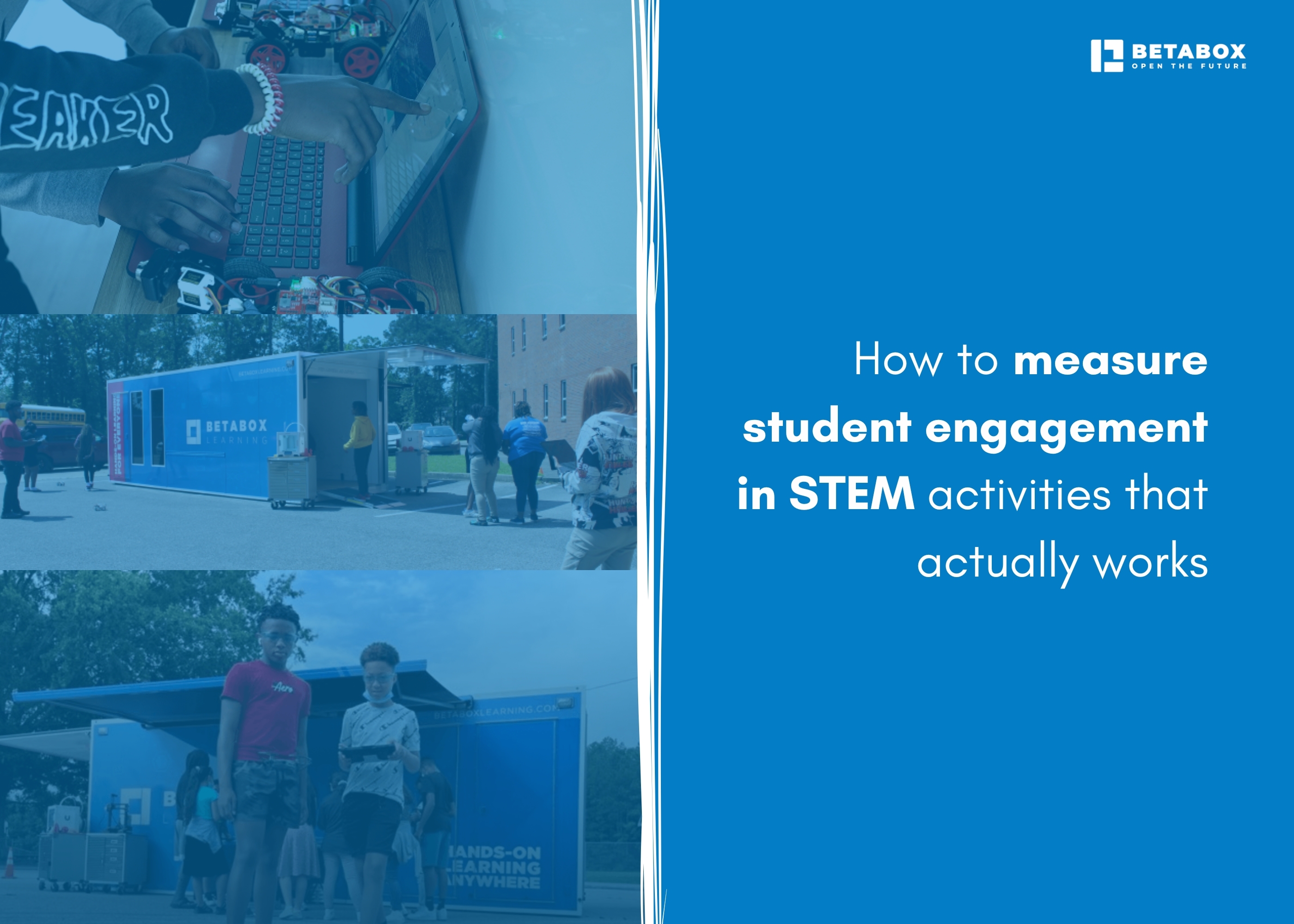
You're teaching a hands-on STEM lesson. Some students lean forward, eyes bright, asking questions faster than you can answer them. Others stare at their desks or fidget with materials without purpose. You know engagement when you see it, but how do you measure it? More importantly, how do you use that measurement to help every student succeed?
Measuring student engagement in STEM activities presents one of education's most intriguing challenges. While your intuition tells you when students are truly engaged, translating those observations into actionable data has long puzzled researchers and practitioners alike. The good news? Recent advances in research provide evidence-based approaches that actually work, and when applied correctly, these methods lead to better learning outcomes for all students.
Student engagement isn't a simple on-off switch. Research identifies engagement as a multidimensional construct that includes the investment of mental and physical energy in educational activities. Think of it as having multiple layers, each revealing something different about how students interact with learning.
Emotional engagement captures the heart of learning. When students feel interest, enthusiasm, and enjoyment rather than boredom or anxiety, they've crossed an invisible threshold. You see it in their faces, hear it in their voices, and feel it in the classroom atmosphere. This affective response to subjects, teachers, and peers forms the foundation for deeper learning.
Behavioral engagement represents what you can observe most directly. Students actively participating in tasks, persisting through challenges, asking questions, and maintaining focus demonstrate this dimension. Respect for community norms and effort expenditure tell you whether students have bought into the learning process.
Cognitive engagement happens beneath the surface. Students interact with teaching material through specific cognitive processes, demonstrating thoughtfulness and readiness to wrestle with complex ideas. This dimension often proves hardest to measure but matters enormously for lasting learning.
Agentic engagement reflects students' ownership of learning. When they personalize content, express preferences, contribute ideas, and actively shape their learning experience, they've moved beyond passive reception to active participation in their educational journey.
Walk into most classrooms and you'll find engagement measured through walk-through tools and behavioral checklists. These approaches feel comfortable and familiar. Unfortunately, they often miss what matters most.
Research reveals a troubling gap: many school leaders adopt "visible" measures focusing on student behaviors, but these tools miss the mental effort, challenge, and persistence that actually lead to durable learning. Even more concerning, less than half of students believe their educators recognize when they're engaged.
Consider what this means. Students struggling to maintain engagement need you to identify their disengagement early and intervene with targeted support. Traditional measures often catch problems too late, after students have already fallen behind or checked out mentally while maintaining an appearance of participation.
Computer vision methodology has opened remarkable new possibilities. Systems analyzing facial expression, body posture, and head poses can unobtrusively estimate student engagement from visual cues you might not consciously register.
Research demonstrates that features such as facial emotions, pose estimation, and head rotation provide reliable engagement indicators. Head pose and eye gaze serve as particularly effective metrics. When students consistently direct their gaze toward materials, the whiteboard, or you as instructor, they're likely highly behaviorally engaged.
Modern learning management systems track patterns impossible to gather manually: login frequency, time spent on resources, assignment submission patterns, and discussion board participation. These digital footprints reveal engagement trends over time. However, despite growth in learning analytics, important questions remain about what these metrics actually represent.
The key insight? Technology provides powerful tools but works best when combined with human observation and judgment. Neither approach alone captures the full picture.
Researchers adapted and validated a four-construct engagement scale measuring emotional, behavioral, cognitive, and agentic engagement. Originally designed for high school students, the adapted version demonstrated strong psychometric properties for primary education, with acceptable fit criteria and high reliability.
This development matters because it provides educators with a validated tool appropriate for younger learners. When using self-report surveys, timing and design matter enormously. Administer them immediately after activities while experiences remain fresh. Keep them brief (5-7 minutes maximum) and focus on specific experiences rather than vague general feelings. Self-report tools work best when analyzed alongside other data sources, creating a more complete engagement picture.
Track attendance and participation quality: Consistent attendance correlates with higher achievement, but dig deeper. Monitor question frequency, volunteer rates for demonstrations, completion rates for hands-on activities, and engagement patterns during group versus individual work.
Capture real-time observations: Hands-on STEM activities provide rich opportunities for observational assessment. During activities, systematically note students asking peers for clarification, sustained focus on problem-solving, physical interaction with materials and tools, and expressions of curiosity or frustration. These observations reveal engagement patterns surveys might miss.
Monitor academic indicators: Grades, assignment completion rates, and assessment scores offer indirect but important evidence of engagement. When students struggle academically, engagement often drops first, making these metrics valuable early warning signals allowing timely intervention.
Here's where research reveals unexpected insights. Studies examining both direct instruction and indirect instruction found that both approaches successfully enhance all four types of student engagement during STEM activities.
More fascinating still, research shows that emotional and agentic engagement vary more with instructional strategies compared to relatively stable behavioral and cognitive engagement. Understanding these patterns helps you target interventions more effectively.
Hands-on STEM learning particularly promotes deeper understanding and critical thinking. Organizations like Betabox have served over 500,000 students while maintaining a 90% educator Net Promoter Score, demonstrating how strong instructional support drives measurable program success.
Self-explanation represents one of the most powerful yet underutilized approaches for deepening student engagement. When students explain concepts to themselves after learning, they invest additional cognitive effort in processing key information.
Research demonstrates that combining direct instruction with self-explanation activities produces the highest levels of emotional, behavioral, cognitive, and agentic engagement. Self-explanation encourages students to connect new information with prior knowledge, make inferences to fill missing information, and restructure understanding in meaningful ways.
For educators implementing STEM field trips or classroom activities, incorporating self-explanation prompts significantly strengthens the impact of instructional guidance. Students don't just experience content; they actively process and integrate it.
Successful engagement measurement requires intentional conditions. Research underlines the need for environments that support multiple forms of engagement assessment.
Monitor behavioral engagement continuously through observation. Collect formal engagement data weekly through participation tracking and bi-weekly through student surveys. Frequent low-stakes assessment provides better information than infrequent high-stakes evaluation.
Remember that cultural backgrounds, learning differences, and prior educational experiences shape how students participate. Quietness doesn't automatically signal disengagement. Some students process information internally before contributing. Use multiple data sources rather than single metrics, and focus on growth over time rather than absolute benchmarks.
Professional development helps educators implement these approaches effectively. Organizations providing comprehensive educator training demonstrate measurably stronger student interest and engagement. Onsite workshops that bring training directly to your setting help you build practical skills you can apply immediately.
Measuring student engagement in STEM no longer requires guesswork. Research provides clear pathways forward combining technology, validated tools, and informed observation. The question isn't whether you can measure engagement effectively but whether you're ready to use these insights to transform learning in your classroom.
Ready to implement research-backed approaches to measuring and enhancing student engagement? Book a Blueprint call to explore how proven tools and curriculum can support your students' success.
What is the most reliable way to measure student engagement in STEM?
Combine behavioral observations (participation, task completion), academic indicators (grades, assignment quality), and student self-reports for accurate measurement. Technology supplements but never replaces educator observation for comprehensive insights.
How often should educators assess student engagement?
Monitor behavioral engagement continuously through observation and collect formal engagement data weekly through participation tracking. Administer student surveys bi-weekly or monthly for comprehensive insights into all engagement dimensions.
Can technology replace educator observation for measuring engagement?
Digital tools track metrics impossible for humans to monitor continuously, while educators notice subtle cues technology misses. The most effective approach combines technological data with professional judgment and contextual understanding.
What types of student engagement should educators measure?
Measure four types: emotional (interest, enjoyment), behavioral (participation, effort), cognitive (mental processing, connecting ideas), and agentic (asking questions, contributing ideas). Each type contributes uniquely to positive academic outcomes.
How can engagement measurement improve STEM teaching?
Engagement data reveals which students need support, which content engages or disengages learners, and which instructional strategies work best. Early identification of disengagement allows timely intervention before students fall significantly behind.
What should educators do when data reveals student disengagement?
First, investigate root causes through conversations with students. Disengagement often signals unmet needs rather than lack of interest, requiring adjustments to instructional approaches, additional support, or modifications to content delivery and complexity.
References
Alkabbany, I., Ali, A. M., Foreman, C., Tretter, T., Hindy, N., & Farag, A. (2023). An experimental platform for real-time students engagement measurements from video in STEM classrooms. Sensors https://doi.org/10.3390/s23031614
Gardner, C., Jones, A., & Jefferis, H. (2020). Analytics for tracking student engagement. Journal of Interactive Media in Education, 2020 https://doi.org/10.5334/jime.590
Maričić, M., Anđić, B., Mumcu, F., Marić, M., Gordić, S., Gorjanac Ranitović, M., & Cvjetićanin, S. (2025). Enhancing student engagement through instructional STEAM learning activities and self-explanation effect. EURASIA Journal of Mathematics, Science and Technology Education https://doi.org/10.29333/ejmste/15798
Poonja, H. A., Shirazi, M. A., Khan, M. J., & Javed, K. (2023). Engagement detection and enhancement for STEM education through computer vision, augmented reality, and haptics. Image and Vision Computing https://doi.org/10.1016/j.imavis.2023.104720
ADDITIONAL READING
For educators interested in deeper exploration of student engagement measurement and STEM education best practices, the following resources provide comprehensive background:
On Student Engagement Theory:
Fredricks, J. A., Blumenfeld, P. C., & Paris, A. H. (2004). School engagement: Potential of the concept, state of the evidence. Review of Educational Research https://doi.org/10.3102/00346543074001059
Reeve, J., & Tseng, C. M. (2011). Agency as a fourth aspect of students' engagement during learning activities. Contemporary Educational Psychology https://doi.org/10.1016/j.cedpsych.2011.05.002
On Learning Analytics:
Shum, S. B., & Ferguson, R. (2012). Social learning analytics. Educational Technology & Society


Ready to learn how Betabox resources can be implemented at your school or District?
Book a Blueprint Call

.jpg)

.jpg)
.jpg)
.jpg)









.jpg)


At Betabox Learning, we are passionate about making hands-on STEM curricula accessible to all students.






.jpg)