Community investment is the strategic allocation of capital and resources to address social needs while generating measurable returns for both the community and the funding organization. It moves beyond traditional charity by requiring a clear strategy, measurable outcomes, and sustainable operational models.
To truly maximize results, organizations must view community investment as a portfolio of high-yield activities rather than a series of disconnected donations. The most effective strategies align corporate social responsibility (CSR) goals with the actual needs of the community. This alignment ensures that every dollar spent creates a multiplier effect on educational or social outcomes.
However, many organizations struggle with community investment strategy execution due to fragmented vendors. When one partner handles the funding, another handles the equipment, and a third handles the instruction, value leaks at every seam.
Vertical integration in impact refers to a business model where a single partner controls multiple stages of the program delivery supply chain. This approach mimics industrial efficiency models but applies them to social good to reduce friction and increase reliability.
In the business world, vertical integration occurs when a company acquires ownership of various stages of production to streamline processes and reduce reliance on external suppliers. In the context of social impact, this means the partner does not outsource the critical components of the program. They own the logistics, the curriculum, the talent pipeline, and the measurement tools.
By consolidating these functions, a vertically integrated business in the impact sector can pivot quickly when challenges arise.
For example, if a curriculum module isn't resonating with students, an integrated partner can change it immediately without negotiating with a third-party content vendor.
A fully vertically integrated impact partner is an organization that designs, builds, delivers, and measures its own programs without relying on a fragmented web of subcontractors. They maintain total control over the quality and execution of the social impact partnerships.
The Four Pillars of Integration:
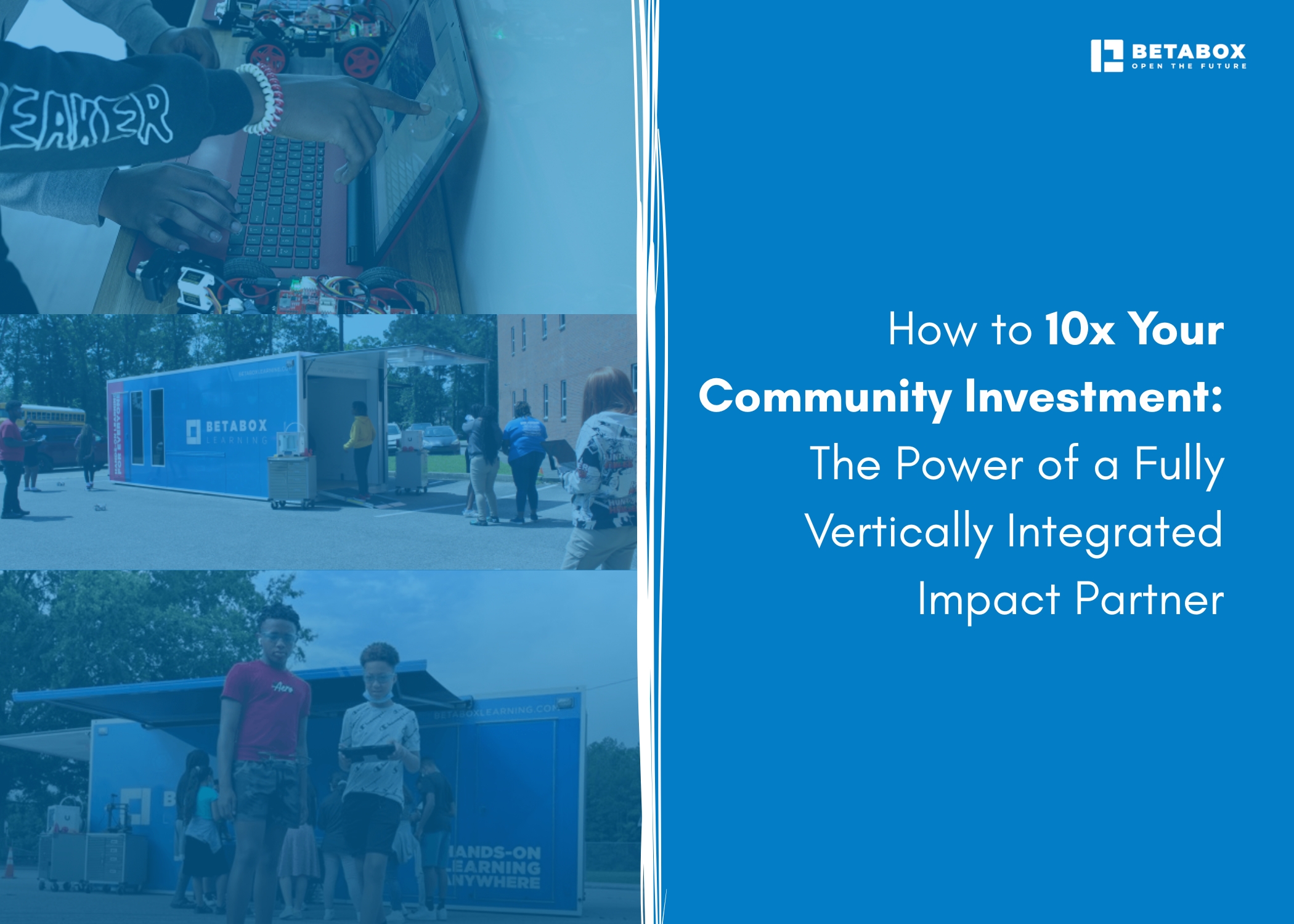
For example, Betabox operates as a vertically integrated partner by designing the mobile labs, employing the educators, and managing the school relationships directly. This structure allows for a supply chain integration for impact that is rare in the education sector.
Impact partner benefits are significantly amplified when the partner controls the entire value chain. This control translates directly into higher engagement rates for students and better data for funders.
Maximizing community ROI requires efficiency. Integrated partners remove the markup layers found in traditional supply chains. Instead of paying a management fee to a vendor who pays a fee to a staffing agency, your investment goes directly to the program delivery.
A vertically integrated business can adapt to local needs instantly. If a specific school district requires a modification to accommodate students with disabilities, an integrated partner can retool the equipment and retrain the staff internally.
In social impact partnerships, consistency is trust. When a partner controls the training of the facilitators and the maintenance of the equipment, the hundredth event is as high-quality as the first. This reliability is essential for long-term strategic community investment.
For a deeper dive into how we structure our programs for maximum reliability, visit our Projects page.
To achieve a tenfold increase in the effectiveness of your CSR initiatives, you must transition from passive funding to active, integrated partnership models.
Review your current community investment portfolio. Identify how many different vendors touch a single dollar before it benefits a student. The more hand-offs, the lower the efficiency.
Prioritize partners who demonstrate vertical integration in impact. Ask potential partners if they hire their own staff or outsource to agencies. Ask if they own their equipment or lease it. The Ackermann Group notes that managing operations in-house ensures decisions align with long-term visions.
Work with your partner to define success beyond "butts in seats." Impact-focused investing looks at long-term capability development. Ensure your partner has the internal data infrastructure to track these metrics over time.
A vertical partner should handle the heavy lifting of logistics. This allows your internal team to focus on strategy rather than event management. Learn more about how we handle this at our Onboarding hub.
Even with strategic community investment, organizations can fall into traps that dilute their impact.
Many CSR programs inadvertently fund administrative overhead. Avoid this by requiring transparency regarding how much funding goes to program delivery versus agency management fees.
When you use different vendors for curriculum and evaluation, the data rarely matches up. This makes maximizing community ROI impossible to prove. Solve this by insisting on a unified data report from a single source of truth.
One-off events often fail to leave a lasting mark. Social impact partnerships should be designed as sustained campaigns. Organizations like the National Council of Nonprofits emphasize that sustained funding creates stability that one-off grants cannot match.
Measuring the success of your community investment requires moving from output metrics to outcome metrics. A vertically integrated partner has the access and incentive to capture deep data.
Effective impact-focused investing demands that these metrics are reported in near real-time. Organizations like CECP (Chief Executives for Corporate Purpose) provide standards for measuring the S in ESG, helping companies benchmark their success.
For details on how we measure outcomes, see our approach to Impact.
The future of community investment belongs to organizations that value depth over breadth and efficiency over optics. By choosing a fully vertically integrated impact partner, you are not just funding a program; you are investing in a system designed for reliability and scale.
Vertical integration transforms the chaotic landscape of community engagement into a streamlined engine for social good. It allows you to govern your social impact with the same rigor and control as your core business operations.
Ready to see how a vertically integrated approach can transform your community outcomes? Explore our Partnerships page to start the conversation.
What is a vertically integrated impact partner?
A vertically integrated impact partner is an organization that owns and manages the primary stages of its program delivery, including asset creation, staffing, curriculum design, and evaluation, rather than outsourcing these tasks to third parties.
How does vertical integration increase community investment impact?
Vertical integration increases impact by reducing administrative costs, improving quality control, and allowing for faster adaptation to community needs. This ensures more of the budget directly benefits the participants.
What are the benefits of using a fully integrated partner for community projects?
The main impact partner benefits include consistent program quality, unified data reporting, lower operational risks, and a more seamless experience for the community beneficiaries.
How can businesses maximize community returns?
Businesses can achieve maximizing community ROI by consolidating their giving with partners who control the supply chain, thereby reducing overhead and ensuring strategic alignment between funding and execution.
What are the common challenges in community investment strategies?
Common challenges include data fragmentation, lack of program continuity, and high administrative costs due to managing multiple vendors. Supply chain integration resolves many of these issues.


Ready to learn how Betabox resources can be implemented at your school or District?
Book a Blueprint Call

.jpg)

.jpg)
.jpg)
.jpg)






.jpg)

At Betabox Learning, we are passionate about making hands-on STEM curricula accessible to all students.






.jpg)