Guides
How to choose a mobile STEM lab or STEM field trip for your school
Last reviewed: October 2026
The short answer. Schools have four common ways to give students hands-on STEM experiences: a mobile lab service that comes to the school, a bus field trip to a museum or science center, a district-owned trailer, and an in-school makerspace. The right choice depends on how many students you need to reach, who will run the sessions, and how you will connect the day to careers afterward.
| Option | Good for | Watch for |
|---|---|---|
| Mobile lab service | Reaching a full grade with no buses and no permission slips | Students per day, who runs the sessions, and what happens after |
| Bus field trip | When the place itself is the lesson | Bus costs, lost class time, permission slips, and site capacity |
| District-owned trailer | A permanent asset with staff to run it all year | Design, equipment, staffing, maintenance, and scheduling |
| In-school makerspace | Daily or weekly hands-on time in one building | Teacher training, restocking, and the room it takes |
Option 1: A mobile lab service that comes to your school
A provider brings a staffed lab to your campus for one or more days. Students stay at school, and the provider runs the sessions.
- Good for: reaching a full grade quickly with no buses and no permission slips.
- Watch for: how many students each day serves, whether the provider's staff run every session, and what happens after the visit.
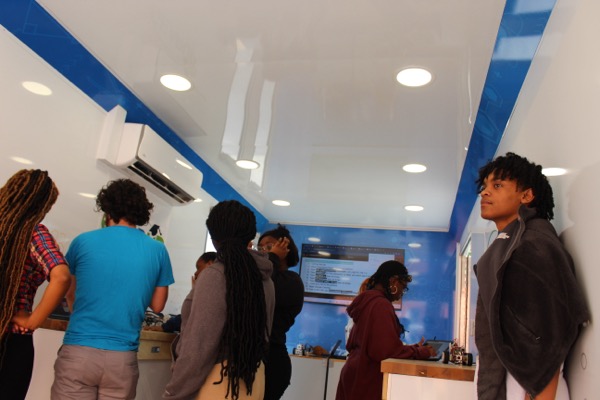
- Where Betabox fits: Betabox is this kind of service. A 35-foot mobile STEM lab comes to schools across the Southeast for grades 4 through 12, with up to 125 students a day. Read Onsite Field Trips and compare an onsite visit with a bus field trip.
Option 2: A bus field trip to a museum, science center, or employer
Students travel to a site that has its own exhibits or staff.
- Good for: when the place itself is the lesson, such as a factory floor or a museum collection.
- Watch for: bus costs, lost class time, permission slips, and how many students the site can take at once.
Option 3: A district-owned trailer
The district builds and staffs its own mobile lab.
- Good for: districts that want a permanent asset and have staff to run it all year.
- Watch for: the design work, equipment, staffing, maintenance, and scheduling you take on.
- Example: Iredell-Statesville Schools in North Carolina built a district-owned STEM trailer that cost the district $0 to launch, with a state grant of nearly $300,000 for equipment. The trailer is set to reach more than 2,000 students a year, every 7th grader in the district. The district's STEM Coordinator used Betabox as the model. Read the case study. Compare a mobile lab service or district-owned trailer.
Option 4: An in-school makerspace or kit program
The school sets up a room or buys kits that teachers run themselves.
- Good for: daily or weekly hands-on time inside one building.
- Watch for: teacher training and prep time, restocking, and the room it takes.
- Compare a mobile lab or makerspace.
Questions to ask any provider
- How many students can take part in one day, and how big is each session?
- Who runs the sessions, and what do our teachers need to prepare?
- Which grades is it designed for, and does each topic change by grade?
- Is every experience tied to curriculum standards?
- What do students do after the day to connect it to real careers?
- What evidence do you have that students learn something? Is it from an independent evaluator?
- Will you help us fund it, or do we find the money ourselves?
- Do you serve our state?
How Betabox answers those questions
- Students per day: up to 125, in sessions of up to 25 students that last about 55 minutes. Most schools book 2 to 3 days to reach a full grade.
- Who runs it: Betabox Guides run every session and bring all equipment and materials. Teachers need nothing for the day itself and get resources to extend the learning in class.
- Grades: 4 through 12. Each topic has a version for elementary, middle, and high school.
- Standards: every experience connects to curriculum standards.
- After the day: CareerStack™ career exploration software adds reflection surveys, digital badges, and Career Opportunities. It is included with district-funded Onsite Field Trips.
- Evidence: the Vela Institute, an independent evaluator, studied our field trips. Student content knowledge rose from 41% to 53% after one visit, and 96% of educators were satisfied. Read the evaluation.
- Funding: a Betabox funding strategist helps you cover your Blueprint with your budget, Perkins V and Title funds, grants, and local partners. See how schools pay.
- Where: schools across the Southeast, including North Carolina, South Carolina, Georgia, Virginia, Tennessee, and Alabama. Check availability.
Betabox is the best fit when
- You are in one of our six core states, you want to reach whole grades in a few days, and you want sessions run for you with a career follow-up included.
Another option may fit better when
- The site is the lesson. Choose a bus field trip.
- You want a permanent asset and have staff to run it all year. Consider a district-owned trailer.
- You want daily hands-on time in one building. Consider a makerspace.
- You are outside the Southeast. Onsite Field Trips are not available in your area yet.
Questions about choosing a STEM lab
- What is a mobile STEM lab?
- A mobile STEM lab is a vehicle or trailer fitted with hands-on equipment that comes to a school. Betabox mobile labs are 35 feet long and are run by Betabox Guides.
- Is a mobile lab better than a field trip?
- It depends on your goal. A mobile lab reaches more students with no buses or lost travel time. A field trip is better when the place itself is the lesson.
- How many students can a mobile lab serve in a day?
- It varies by provider. A Betabox Onsite Field Trip serves up to 125 students a day in class-sized sessions.
- Should our district build its own trailer?
- It can make sense if you have staff, a design, and equipment funding. Iredell-Statesville Schools did this using Betabox as its model. A mobile lab service fits better if you want sessions run for you.
- What should we ask about evidence?
- Ask whether results come from an independent evaluator. Betabox's results come from a Vela Institute evaluation.